VANITY FAIR SAMPLER PIECES:
- Hannah
- Feb 6, 2021
- 5 min read
Updated: Feb 13, 2021
PREPRODUCTION:
I made sure that I followed the codes of conduct and didn't violate any rules and regulations of the Editor's Code Of Practise, this means that I did not harm the safety of my model / celebrity and didn't compromise their mental health either during the photoshoot nor interview. This is important so that I don't compromise the health nor reputation of those involved.
PRODUCTION SCHEDULE:
To make the sampler's pieces I need to ensure that I have a production schedule laid out so that I have timelines to follow. I find this highly useful as it makes sure that I have everything written out that I need to complete, by being in a timeframe it means that the whole process will be done on time and if done on time I will have time at the end in case there are any developmental issues and I need to push some dates back. One example of this being the weather, for my photoshoots for my goal was to shoot outdoors so on some days on rained and we therefore couldn't complete this. The weather however picked up and the snow made a great background for just waiting a few days it really looks good for the photos (including the one of a kettlebell in my DPS). I chose to only have one photoshoot for my front cover and DPS as it would give continuity and make sense since the front cover advertises the double page spread.
Finances were important as I needed to make sure that everything was available. For the tasks that I decided to use it was pretty much free for me as all the resources I used I already owned (including clothes and technology) meaning that I had a lot more free reign during my project. For example, with editing I used a free website called photopea for my back, and for my other resources I used my photoshop that college has paid for. For my camera I used my phone since it it one of the most recent models meaning that the camera being a few months old will give me a great camera without hiring or purchasing a professional camera.
FRONT PAGE:

With my theme being active and sports wear I first decided to reflect this in my front page, so my model was going to be physically moving as a still was captured from this. With this in mind, this example to the left was perfect inspiration, in terms of the model not filling up the page - as they usually do. When putting my front cover I found that the text I was putting on the page was not suitable to fit the background - the colours of my photo were inconsistent meaning that I did not have enough block colours for the coverlines, date or model credit. The original photo I chose is below, my Photoshop file refuses to load. This image makes the model seem very small and too far away for it to be clear that she is THE main coverline.

My new photo I think works very well because it has a modern take and shows clearly that the main coverline is about this particular celebrity. The text all fits around her body well and allows for all the needed features unlike the other, and still looks like it isn't too cluttered. The coverlines, date, dedication to Women's Month, as well as the masthead as the skyline, these are typical codes and conventions of Vanity Fair magazine front covers and can be seen on my sampler example well. This is something very important to have fit comfortably so that the piece is as realistic as possible as most front covers have some free space around the text and features.
DOUBLE PAGE SPREAD:
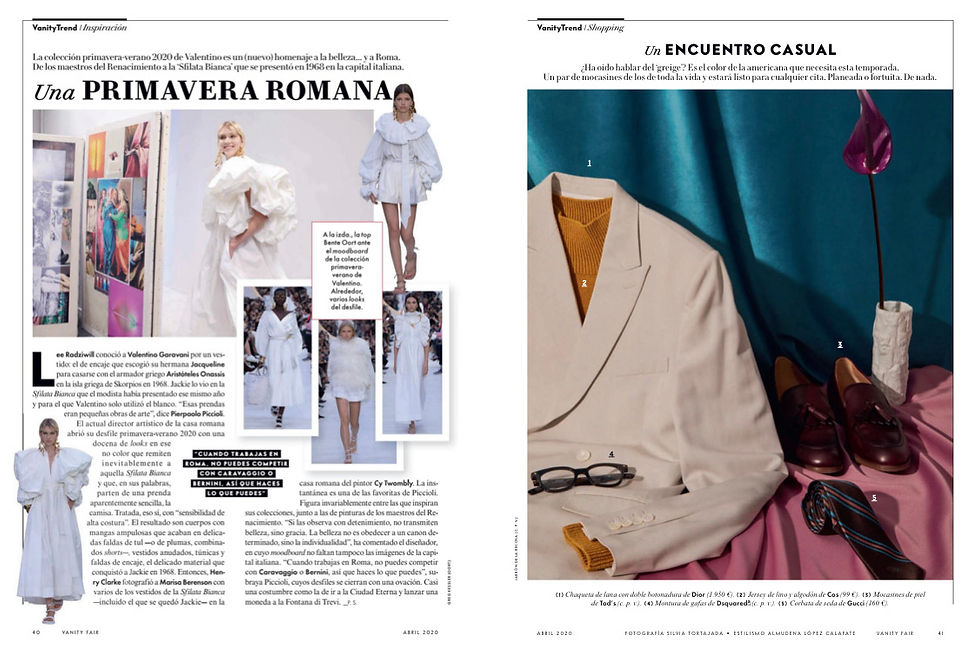
After researching the internet looking for some inspiration for my piece / DPS I found this piece below which I found worked very well with my concept of my work. One reason being I plan to use multiple primary photos which I could use which would be relevant to the front cover's photo and each of the photos on these two pages. By using these different techniques - such as pull quotes, photos and sub headings - the DPS becomes more full, more realistic and much similar.
FEEDBACK:
Once I felt I had completed my DPS I contacted one of my superiors to gain some feedback from some fresh eyes, his constructive criticism helped me see some little things which made the DPS seem more realistic without being a big job.
1: Should the graphic on the top right be on the other side? I mean the far right so it mirrors the left page. In regards to this, I kept it the same (once I explained this to my superior he said it was 'fine as long as I was following the conventions') because as you can see in my example above, I used this technique to replicate the actual magazine's conventions.
1: There is a bit of white space at the bottom of the column on the right page. If you add a bit more copy into the line that ends 'things even if they aren't published' so that the question that follows moves onto the next column, that should fix that. We can see below what he was referring to, and I saw that it did in fact cause some symmetry issues so I made sure that this

was amended. I removed some lines and put them onto the right half of the copy, which (in the amended version below this) made the piece seem much more
easy on the eye, a big part of making it more

realistic for an audience to pick up a copy.
2: 'Just need to remove the orphan - the word on its own - 'upset' See if you can add a few words here.'
To this feedback I realised that the text on both halves (much more noticeable on the

right side) went below the boarder lines which go down the page to ensure some space around the edges. I edited some text to make sure that this was also changed, the final piece shown to the left. You can clearly see the difference, the space between the copy and folio along the bottom (Vanity Fair and the page number) mirror the space all around the edges of the whole double page spread, a detail which would not be left in an actual issue of Vanity Fair, this gives realism.
Below we see the copy I used for the text, the highlighted text in blue represents how I've edited the copy for reasons such as flow, grammar and corrections of my superior as mentioned.
BACK PAGE ADVERT:
My advertisement for the back page is for Apple's infamous AirPods, their house style in advertising remains to be simplistic yet sleek, so I thought I could easily replicate this. A piece of modern technology would also fit well with Vanity Fair's target demographic of teenagers to young adults, this age also blends well with the demographic of Apple as their products get bought for younger generations each year.
I gained inspiration from this advert below as an example, like most Apple Adverts, simplicity is the key to their marketing, almost one of their USPs. This is because they don't want to use complicated images or adverts, they want the product to sell for what it is, which is why they rarely mention price in their advertisements.

To make my advert I used photopea and during editing I inverted the photo by accident, this made the AirPods turn black - despite there being no black AirPods currently - I thought this really cool and would be great to market. It has been rumoured for there to be black AirPods for few years, so by making this a cover really increases publicity, especially since they are currently desired by Apple's public. Despite the new concept of black AirPods, I kept the house style of simplicity to heighten the realism of the ad.
THE FINAL PRODUCT:
Overall I think this sampler is very similar to Vanity Fair's own issues and that there is a high realism meaning that I completed my job.
Comments